13th April 2013
Formative assessment
“If children do not learn the way we teach…perhaps we should teach the way they learn”
(Epig, 1981)
The vision is to develop students in the competencies they need to be confident, connected, actively involved and lifelong learners in order for them to realise their potential (MoE, 2007). Teachers need to continually grow and improve the learning of their learners, which is also known as ‘formative assessment'. Formative assessment is a daily, continual process of teacher and students investigating, discussing, describing, questioning and judging learning outcomes (Hill, 2008).


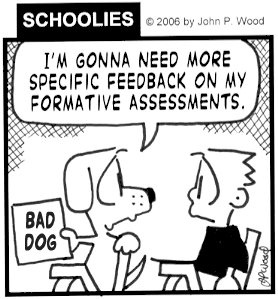
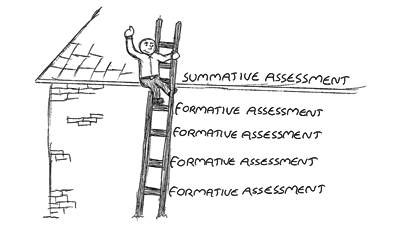
These pictures show what I have learned formative assessment is. It is primarily done in partnership with the student, where communication, understanding and feedback is of high priority, with the main purpose to guide and improve teaching and learning in the classroom.

My teaching philosophy is centred in the humanist and social constructivist beliefs, where I value building inter-classroom relationships, making learning meaningful and encouraging all students to participate in the learning. Because of my beliefs and teaching approach formative assessment would naturally occur in my classroom.
On reflection, I can see how formative assessment was implemented in the classroom as the teacher discussed and set clear learning intentions for tasks with success criteria for individual students. The success criteria were not hidden from the students and I can see how this created meaningful learning experiences in the classroom. I have come to learn that understanding each student, their learning needs and how to best assess them, will enhance student achievement (MoE, 2007). In my classroom formative assessment will be done on a daily basis, which will significantly involve the students, as they engage in tasks and activities. I will incorporate the self-assessment and peer-assessment approach of questioning, discussing and giving feedback, which will elicit evidence of learning. I believe that the process of engagement and self-assessment will give the students ownership of their own learning, creating independent learners who are engaged and motivated to achieve goals they believe are relevant and meaningful (MoE, 2007). I have also realised the importance of giving students constructive feedback on their work as it relays to students what they have achieved and how they can improve, which is a source of encouragement and motivation for them to achieve their goals.
The following strategies for formative assessment are supported by Groundwater-Smith, Ewing and Le Cornu (2006), Hill (2008) and Krause et al (2010).


This picture shows a teacher listening and observing a student. As a teacher it is vital to know individual learners and how to assess them for learning. On practicum, I observed how teachers provided constructive feedback to the student, sharing with them what is required in order for them to meet their goals. This gave the students ownership of their learning and encouraged them to succeed.
I have observed this picture of formative assessment where the teacher clearly identify the learning outcomes and achievement objectives with students. On reflection I can see how the teacher was willing to share and engage in the learning process with the students through discussion, questioning and observation which is a form of assessment for learning
This picture shows an image of self-assessment or peer-assessment, which I have learned is also a form of daily formative assessment.
A misconception I use to have in regards to assessment is that it mainly involved testing, reporting, marks and grades. I do not recall being aware of assessment for learning in my schooling years, I do however recall being bombarded with exams, tests and quizzes, which did not create a motivating and meaningful learning experience. During my placement I was not aware of assessment happening in the classroom due to my misconceptions, but as I reflect back I can see that a lot of formative assessment where taking place on a daily basis. The teacher set clear learning outcomes with the students and always ensures cooperative group work was happening with meaningful discussions and questioning in place. Now I have come to realise that formative assessment is the most effective way to assess for learning on a daily basis, which will motivate, engage and steer studetns to experience learning success in a meaningful way.