Good and Brophy, (2003), stated that there is a well-documented correlation between classroom management and learning. I have come to learn that with effective classroom management students can become more engaged and less disruptive, which provides increased learning opportunities and student achievement. Kauchack and Eggen (2007) support this by saying “teachers have the ability to create a productive learning environment, which is a classroom that is orderly and focussed on learning” (p. 184). I believe the ability to create such a learning environment links to the teaching strategies and beliefs that we as teachers hold.

I'm a description. Click to edit me

I'm a description. Click to edit me

I'm a description. Click to edit me

I'm a description. Click to edit me

I'm a description. Click to edit me

I'm a description. Click to edit me

I'm a description. Click to edit me

I'm a description. Click to edit me

I'm a description. Click to edit me


4th April 2013
Classroom Management
"Effective teachers focus on things they can do something about – and it is always their own behaviour" (Gordon, 1996)

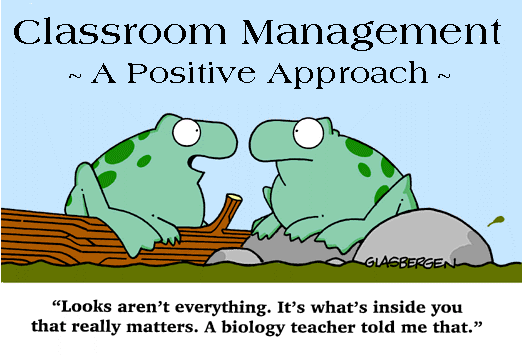
This pictures expresses a positive attitude towards behaviour and classroom management, which link to what I believe and is supported by Krause, Bochner, Duchesne and McMaugh (2010) who states “as a teacher your task is to find a philosophical approach to classroom management and organisation that is congruent with your personal values and beliefs” (p. 543).


I believe drawing from all three learning theories (behaviourist, social-constructivist and humanist) a well-balanced, manageable learning environment can be created. Krause et al., (2010) explain that most teachers adopt several different approaches and that a more comprehensive approach is essential for classroom management, “then, the classroom has an atmosphere of cooperation, balance and mutual trust” (p. 543).
I would incorporate all three learning theories in my management approach, using the “backbone” approach, mentioned by Yates & Ussher (2008), as my foundation to help ‘balance’ and guide my teaching. This is because the ‘backbone’ approach, which ties in with the humanistic and social-constructivist learning theory, creates a democratic classroom environment, where students’ needs are listened too and successful teaching strategies are employed. This approach involve students in the decision making process regarding rules, routines and consequences creating an environment where there is a shared ownership approach which positively impacts on learning and behaviour management.
To strengthen my approach I would rely on different strategies such as planning, which looks at the physical environment, learning activities, student needs, time and space. This is outlined by Kauchack and Eggen, (2007) as a strategy which ensure teachers are prepared for their environment and have given thought to their learners and the relevance of the teaching material. As a student teacher at Newstead School I can relate to the importance of planning when I had to take 26 students for swimming lessons. I had to plan, effectively considering time and space, in order to present clear instructions, rules and activities to engage students in a safe learning environment.

Presenting relevant teaching tasks and resources is another strategy discussed by Krause et al., (2010) to ensure students are engaged and they do not become distracted or “off task”. I have observed this in classrooms where students are given different tasks to complete, which is more suited to their learning needs, keeping them engaged and focussed.
Another strategy, which I think is very valuable, is "group management to facilitate engagement" where Krause et al., (2010) suggests organising the classroom around set activities that vary in terms of how students are involved. This will also support the teacher to monitor learning, mentioned by Yates and Ussher (2008), which includes; observation, questioning, discussion, additional individual instructions and practice examples to keep students on task in learning focussed classroom.


This picture is a perfect example of what could be 'group management to facilitate engagement'. The teacher is monitoring learning and the students seem to be engaged in the learning - which is an excellent management strategy
It is worth mentioning that there is a place for the behavioural or “brickwall” (Yates & Ussher, 2008, p. 105) management approach in my teaching style but only on occasions where safety is of the issue. For example; when I took the 26 students for swimming lessons I had to take on this approach, which was direct and rigid to ensure the safety of the students.

My belief is that teachers are ultimately responsible for the learning environment created in the classroom. My classroom management style would express my beliefs which have woven into it all three learning theories, with the backbone approach as my foundation, which will significantly and positively impacts on my management for learning and student success.
These quotes go hand-in-hand with what Jones (2005) expressed when he said that there are there are two goals, which teachers need to consider, in order to create a productive and manageable learning environment. The first is to maximise student engagement in learning and the second is to give students ownership of their learning. In order to achieve this teachers have to steer a balanced course between two extremes; a harsh regime of “thou shall” and relaxed approach where anything goes.